
Oil And Gas Mechanical Engineering Services In Malaysia: How Industrial Mechanical Services Prevent Piping Support Failures

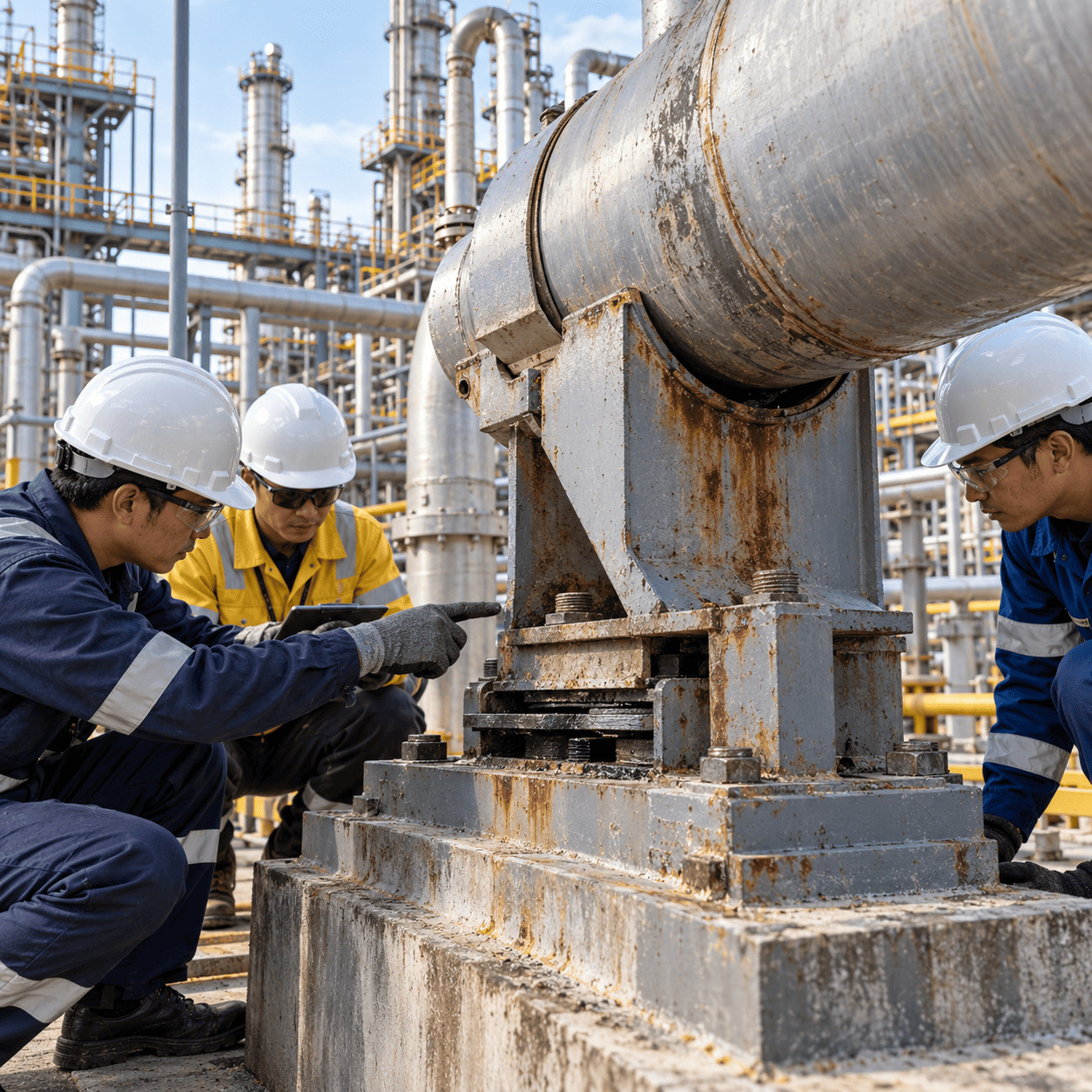
Piping supports are often treated as secondary hardware, but their condition directly influences how loads move through a piping system. A seized guide, displaced anchor, corroded pipe shoe, or incorrectly set spring hanger can redirect thermal movement and introduce excessive forces into pumps, compressors, vessels, heat exchangers, valves, and expansion joints.
In operating plants, these conditions may develop gradually. The first visible symptom might be recurring flange leakage, abnormal vibration, nozzle misalignment, or expansion joint deformation. Effective mechanical engineering services should therefore evaluate the entire load path rather than focusing only on the damaged component.
Industrial Mechanical Services: Why Piping Supports Fail In Operating Plants
Support failure rarely has a single cause. Corrosion, thermal cycling, structural settlement, vibration, incorrect installation, and previous piping modifications can all alter how a support performs.
Common field conditions include seized guides, displaced pipe shoes, deteriorated sliding plates, cracked anchor welds, corroded structural steel, and spring supports operating outside their intended travel range. Temporary supports can also remain in place after maintenance and unintentionally restrict thermal movement.
For experienced industrial mechanical services teams, the key question is not simply whether a support can carry the pipe’s dead weight. Engineers must determine whether it still provides the intended directional restraint while allowing the movements assumed in the piping design.
Oil And Gas Mechanical Services In Malaysia: How Support Failure Transfers Loads
Thermal expansion should produce predictable piping movement when anchors, guides, supports, and flexible elements work as intended. Once a restraint stops behaving as designed, however, the system load path can change significantly.
Consider an axial guide that locks up due to corrosion. Instead of allowing longitudinal thermal movement while controlling lateral displacement, the guide may begin resisting movement in multiple directions. The resulting forces can then migrate toward equipment nozzles, flanges, branch connections, or expansion joints.
Similarly, a deteriorated anchor may allow movement into a piping section that was never intended to accommodate it. Experienced oil and gas mechanical services in Malaysia should therefore consider support behaviour whenever connected equipment develops repeated mechanical problems.
Mechanical Engineering Services For Nozzle Load And Alignment Problems
Pumps, compressors, vessels, and heat exchangers are designed around allowable nozzle forces and moments. Changes in the support system can increase these loads considerably.
For example, repeatedly realigning a pump coupling after shutdown may address the symptom without resolving the cause. If connected piping is imposing excessive loads on the nozzle, alignment problems can return once the system reaches operating temperature.
Likewise, forcing a flange into alignment during maintenance can store strain in the piping system. When the line heats up, that strain combines with thermal movement and may increase nozzle loading, gasket stress, or support reactions.
A proper mechanical engineering services assessment should therefore consider equipment alignment, piping fit-up, nozzle loads, and support condition as an interacting system.
Industrial Mechanical Services And Expansion Joint Overtravel
Expansion joints depend heavily on the surrounding restraint system. Anchors determine where pressure thrust and thermal movement are transferred, while guides control the direction in which the pipe moves.
If an anchor deteriorates, a guide seizes, or a support is repositioned, an expansion joint may begin absorbing movement outside its intended axial, lateral, or angular range.
The bellows may then show excessive compression, extension, lateral offset, or premature fatigue cracking. Replacing the expansion joint without correcting the underlying support condition can reproduce the same failure.
For this reason, industrial mechanical services should include support and restraint inspection whenever premature expansion joint failure is being investigated.
Oil And Gas Mechanical Services In Malaysia: What to Inspect During A Turnaround
Plant turnarounds provide an important opportunity to identify support problems that are difficult to investigate during operation.
Inspection should extend beyond obvious corrosion. Engineers should review:
- pipe shoe position and evidence of abnormal sliding
- guide clearances and signs of binding
- anchor welds and structural deformation
- spring hanger load and travel indicators
- contact between piping and nearby steelwork
- insulation interfering with movement
- temporary restraints that remain installed
- hot versus cold piping positions where movement data is available
For critical lines, oil and gas mechanical services in Malaysia should prioritise supports around rotating equipment, large valves, expansion joints, branch connections, high-temperature piping, and areas with a history of leakage or vibration.
Spring supports deserve particular attention. A spring that has topped out, bottomed out, seized, or been incorrectly adjusted may transfer load into adjacent supports and connected equipment.
Mechanical Engineering Services For Brownfield Modifications
Brownfield plants introduce another challenge: the current field condition may no longer match the original stress model.
Piping may have been rerouted, equipment replaced, valves changed, supports relocated, or operating temperatures increased. Even apparently minor modifications can change system stiffness and thermal movement.
Adding a new rigid restraint, for instance, may solve a local vibration problem while transferring additional forces elsewhere. Replacing a support with a different type can also change movement distribution.
Effective mechanical engineering services should therefore compare the existing configuration against drawings and stress-analysis assumptions before approving permanent modifications.
Industrial Mechanical Services Should Correct The System, Not Just The Damage
Once a support-related issue is identified, corrective action should restore the intended system behaviour.
Depending on the root cause, work may involve repairing anchors, restoring sliding surfaces, adjusting spring settings, correcting guide clearances, replacing corroded structural members, repositioning pipe shoes, or modifying the support arrangement.
In more complex cases, piping stress analysis may be required before finalising changes.
The objective of industrial mechanical services should not be simply to make every support look structurally sound. The goal is to ensure each restraint performs its intended function so thermal movement and mechanical loads transfer predictably throughout the system.
Engage Recovered Energy Engineering For Oil And Gas Mechanical Services In Malaysia
At Recovered Energy Engineering, we understand that piping reliability depends on how supports, piping, expansion joints, valves, pressure equipment, and connected machinery interact.
We provide oil and gas mechanical services in Malaysia for industrial facilities requiring inspection, troubleshooting, fabrication, installation, maintenance, shutdown support, piping solutions, and equipment servicing.
If your plant is experiencing repeated flange leakage, abnormal pipe movement, deteriorated supports, damaged expansion joints, or persistent equipment alignment problems, we can help assess the mechanical system rather than treating each symptom independently.
Our experience across oil and gas, petrochemical, power, marine, and industrial environments allows us to combine engineering understanding with practical field execution. We focus on identifying the underlying mechanical issue, developing workable corrective actions, and supporting implementation around real plant and turnaround constraints.
Engage Recovered Energy Engineering when you need responsive local support and practical mechanical engineering services backed by field experience across critical industrial systems.